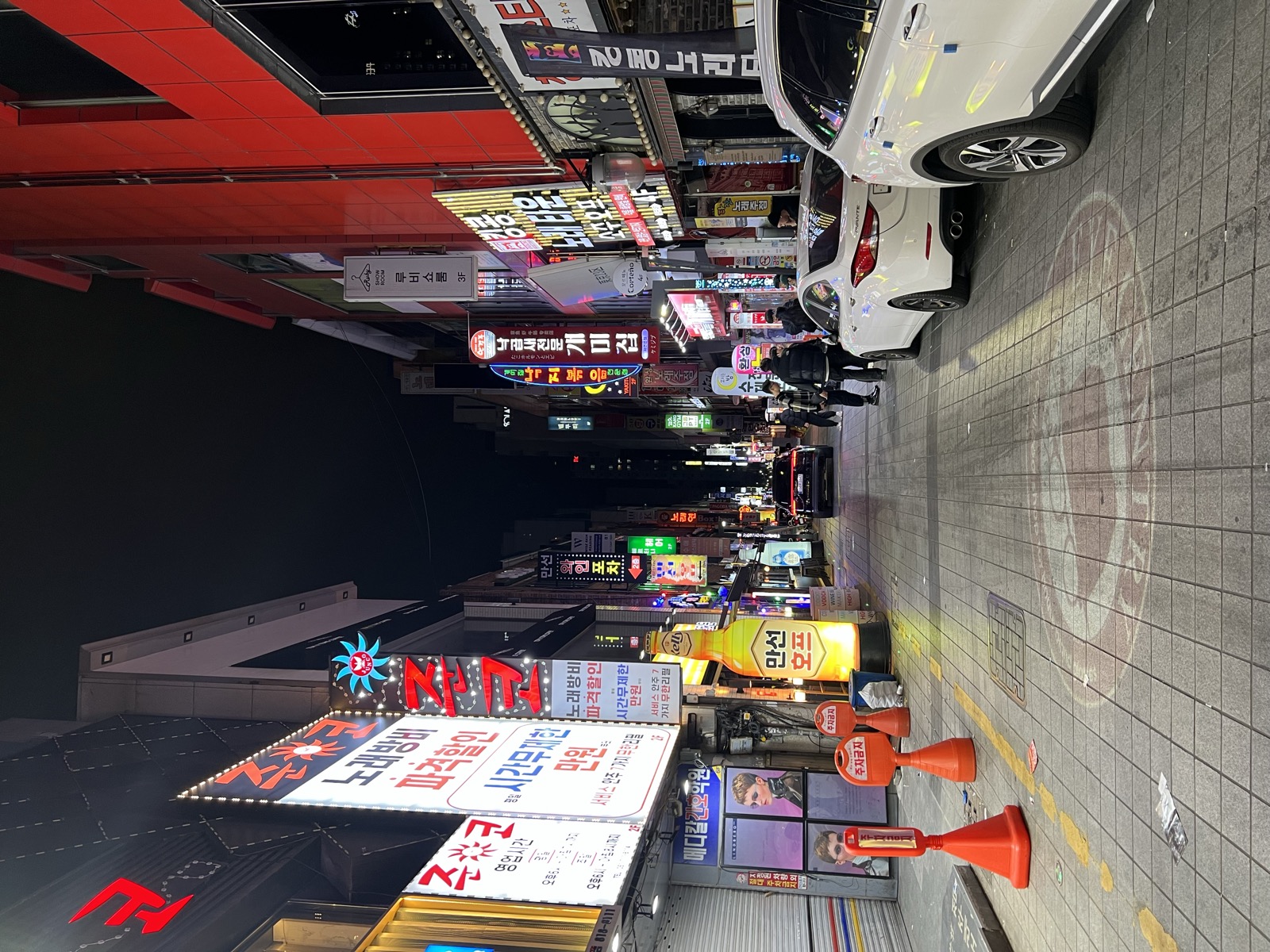
Why care about energy
In today's nations, national security can mean a lot of different things. According to the US's own National Security Strategy (NSS), the US's core national interests are: sovereignty and territorial security, economic prosperity, military superiority, regional stability, strategic resources, technological leadership, and alliances and influence. Due to a lack of a standard international framework for what defines a "secure" nation, I'll use this document for no other reason than I'm American and the US remains the world's leading power, regardless of how you feel about whoever is in charge at the moment.
My focus today in terms of Korean national interests is energy. Energy finds itself called out in the opening pages of the NSS. When asking what kind of country should one want, these exact words are used:
"We want the world's most robust, productive, and innovative energy sector—one capable not just of fueling American economic growth but of being one of America's leading export industries in its own right"
While I think it's safe to say this is what any reasonable country would like to strive for, I think putting energy in the light of economic growth downplays the importance of energy. In this AI crazy world, energy is a prerequisite to entering any meaningful competition on the global stage. I'm currently reading The Technological Republic (the preface at least), and the author, Alexander Karp, calls the 21st century, the century of software. As a software engineer myself, I tend to agree and all the software in the world doesn't mean a thing if the lights don't stay on. Without the internet how is your doctor going to ask ChatGPT what your symptoms mean?
While thinking of national security through this lens, I turn my attention to The Republic of Korea, better known as South Korea. Geographically speaking, South Korea has historically been in a difficult position. In the modern era and before, they've found themselves in the shadow of the middle kingdom, China, and across a strait from a considerable world power, Japan. Even today, they find themselves of interest to the US, which up until relatively recent history, would've never crossed the mind of the average Korean. Given their location, developing independently of the world around them was always and is a considerable challenge. The challenge being, how does a country that constantly finds itself in the crosshairs of international interests secure its own future?
Energy in Korea
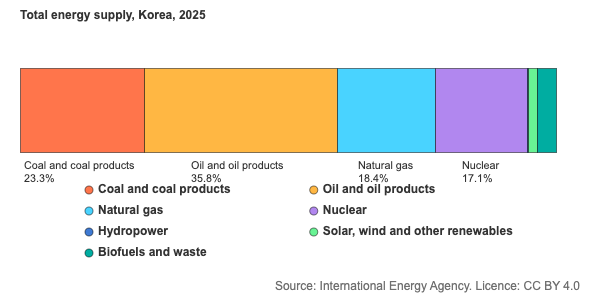
According to the Korea Energy Economics Institute, Korea's Total Energy Supply was approximately 310.5 million toe (ton of oil equivalent) and according to the International Energy Agency (IEA), their TES makeup is as shown in the graphic above. In terms of global scale, their TES is only about 2% of the worldwide energy supply, which is a small number, however, South Korea only accounts for 0.65% of the global population so energy-wise, they are punching above their weight class. It takes one walk down almost any city street to see why.
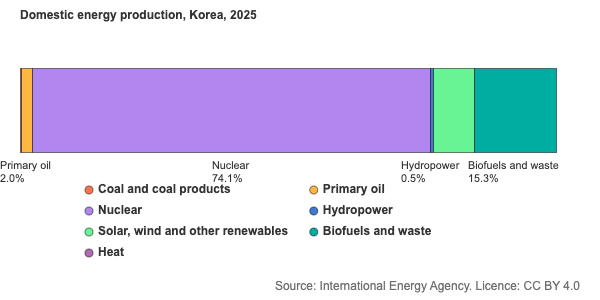
What stood out most to me is the 17.1% nuclear energy. I'm far from an expert on the subject, but I casually never hear much about the nuclear energy of South Korea brought up in day to day conversation. We can probably thank the Hormuz Strait for that. Despite that, nuclear accounts for 74.1% of the domestic energy production with biofuels and waste being the second leader at 15.3%, and renewables coming in third at 6%.
Import Dependence
If we calculate domestic production as a % of TES for 2024, we get that 77.9% of TES relies on imported energy. In their 2025 Energy Policy Review, the IEA cites net energy imports at 83.5% in 2023, so different but not by too much. Which brings us to my main focus: what are the implications of relying so heavily on external sources to fuel one of the world's largest economies?
Luckily, we have a current global conflict to demonstrate the point for us. Prior to the US and Iran conflict, 70% of Korea's crude oil transited the Strait of Hormuz. Qatar alone supplies 15% of Korea's LNG imports. While oil wasn't the only commodity hit by the closure of the shipping lane (65% of Korean helium comes from Qatar which is apparently important for semiconductor manufacturing), its impacts were felt by the entire Korean economy. The Korean Won hit a 17 year low, the OECD cut Korea's growth forecast by 0.4 points, and the KOSPI had its worst single session in its 43 year history.
While the Hormuz crisis illustrated the point best, there are plenty of other ways this could have happened. 30% of Korea's total imports come through the Taiwan Strait and 90% of Korea and Japan's energy imports pass through the broader Strait of Malacca, South China Sea, East China Sea and waters near Taiwan. When the US went to war with Iran, many in the western hemisphere thought China would use that as their opportunity to make their long anticipated invasion of Taiwan. So who truly knows if and when that invasion will occur outside of Beijing.
A lesser known, but potential energy risk lies in Russian dependence. Russia is currently South Korea's 2nd largest coal supplier (2nd to Australia). While sanctions on Russian coal haven't strained this relationship yet, sanctions are a lever the current US administration has shown it likes to pull and could do so in the future.
In response to the Hormuz crisis, the Korean government reacted by lifting limits on coal power generation and increasing nuclear plant utilization, but these short term measures don't equate to a long term solution and to their credit they know that.
A quick aside
At this point I feel obliged to recognize a benefit that has come from the large imports of petroleum. South Korea is the world's fifth largest refiner globally by capacity. In 2024, they exported $49.5B in refined petroleum, making them the 5th largest exporter in the world as well. In fact, during the Hormuz crisis, Europe's jet fuel imports from South Korea spiked to 129,000 bbl/day. The argument for building out refining capacity holds that while crude can be rerouted when traditional shipping routes close, refining capacity is an asset that can't be picked up and moved, which suggests the bottleneck may not always be crude oil, but the refined product itself.
Korea's Electricity Future
In February 2025, the government finalized the 11th Basic Plan for Electricity Supply and Demand.
Here are the bullets from the 11th basic plan:
- Peak electricity demand is expected to grow from 97 GW in 2024 to 129.3 GW in 2038
- The target total generation capacity by 2038 is 158 GW with a goal reserve margin of 22%.
- Electricity consumption up 12%
- The largest driver being semiconductor and data center growth, which is expected to double between 2023 and 2030
Generation mix targets for 2038:
- Nuclear: 35.2%
- Renewables: 29.2%
- Coal: 10.1%
- LNG: 10.5%
- Clean hydrogen/ammonia: 6.2%
- New energy (hydrogen, fuel cells, etc): 3.7%
- Other (your guess is as good as mine): 5.0%
- (Carbon-free share overall: 53.0% by 2030 → 70.7% by 2038)
Closing Thoughts
My initial plan was to give an analysis of the projected energy mix, but in a world with so many moving pieces, shifting alliances, and unforeseen natural disasters, I'd rather address it as its own piece. I also somewhat foolishly realized after doing all of my research for this blog, weighing a country's energy future is a lot more complex than just looking at the electricity plan. My future reading list has already grown quite a bit, starting with the Energy Master Plan and the First Basic Plan for Resource Security.
While nuclear used to suffer from poor publicity, the Korean public had the same general reaction I had to nuclear being the lead energy contributor in the plan. Nuclear and renewables seem like an obvious choice for energy security, but even South Korea's "domestic" nuclear energy generation is sourced 100% from foreign uranium, mostly Russian. And while I personally am a strong believer in renewables having a large share of the energy mix of the future, there are some choke points in the supply chain today and it'll be interesting to see how it plays out in the near future.
Something that occurred to me while reading the plan is that I may be suffering from an American approach to what's important when it comes to energy. In the US NSS, energy security was touted as a necessity to be a leading power. For South Korea, there are hurdles that mean energy independence isn't realistic. South Korea lacks domestic fuel reserves, meaning that although fossil fuels are being phased out, they still account for a minority percentage of the electricity in the proposed plan. Also, due to high population density and tree cover, there isn't realistically enough land for a solar and wind buildout to produce enough electricity to reduce necessary imports to 0 to support an economy that's relatively large compared to the size of the country. A nice problem to have!
So what I can say is that when I think of the future of energy, the ideal mix is what's being proposed by the Korean government, which is encouraging. In my home, the US, any talk of moving away from fossil fuels turns into a political discourse because big oil has long had their money going into the pockets of our politicians. Here that doesn't seem to be the case and even makes me optimistic. It's refreshing to see that a country can agree on the science that's presented to us and build a coherent plan based on that science.